THE GAFFER *** WISHLIST ON STEAM NOW *** OUT 30 OCTOBER 2026 *** £9.99 *** WINDOWS, MAC, LINUX AND STEAM DECK *** THIRTY SEASONS, 1959 TO 1989 *** THE TOWN REMEMBERS EVERY WORD YOU SAY ***

THE GAFFER

THIRTY SEASONS OF ENGLISH FOOTBALL. 1959–1989.

For anyone who misses the football games of the 80s.

Start at the bottom of the Fourth Division in 1959. Climb, or don’t, but everyone you meet remembers which.

A football management game set in the old Fourth Division, played out over thirty real seasons from 1959 to 1989. You pick the side, you take the meetings, and the town keeps its own account of how it went. Made by Pitchwork Studios, a small studio in Cardiff.

CLICK THE CROWD, OR THE BUTTON ABOVE. MENU CLICKS ALWAYS MAKE NOISE

THE GAME, AS IT ACTUALLY RUNS

Real saves. Nothing staged.

THE MATCH, THE TERRACE, THE TRAINING GROUND · FROM THE GAME · 1:22
The club hub in week one: the ten areas, Hooligans Manor with the regulars at the bar, the Snug, and the fixture calendar.
THE HUB & HOOLIGANS MANORTen areas, one club. Below it the Manor never stops: the regulars talk about what is actually happening that week (the last result, the table, a new signing, the money, the weather) and answer each other in their own voices. The six who really run the club wait in the Snug.
Night outside Hooligans Manor: two of the Snug talking on the pavement, the HM sign on its bracket, the last bus waiting at the stop.
OUTSIDE HOOLIGANS MANORThe night you sign your sponsor, two of the Snug step out of the Manor and talk about the new man on the pavement while the bus ticks over at the stop. The regulars come and go, a light goes off upstairs, the HM sign swings in the wind. “Then he’ll find out who really runs this club.” They go round the back, and what they decide there, you never hear.
The chairman's office on the first day: the chairman at his desk, Sandra, Peggy and Doris at work, the board's confidence on the blackboard, the trophy cabinet and the pennants, and three answers to choose from.
THE FIRST DAYThe chairman’s office, the unpaid invoices on the good chair, the office staff at work around you. Say your piece and he answers what you actually said. The board’s confidence is chalked up on the blackboard, and it moves with it. The room changes with the decades, from the pennants and the trophy cabinet to the rugs on the floor.
Club status: the town from above, live, with the ground, the training pitch, the club offices, the bank, the pub, the parade of shops and the town hall, each with its figure.
CLUB STATUS: THE TOWN FROM ABOVEYour club and your town, from above and alive: the ground with your place in the table, the training pitch with the squad’s fitness, the board’s confidence over the club offices, the money at the bank, the regulars at the pub and the town’s belief at the town hall. Traffic, buses, a queue at the chippy, the lads on the rec. A tab for the club, the money, the town or the people.
Club status in the third season: the last six results, the league position game by game at the top of the table, the home gates against the average, the best win and the worst day, and the trophy cabinet with the years engraved and this season's targets in grey.
CLUB STATUS: THE SEASON IN PICTURESThe last six results, the league position game by game, the home gates against the average, and the story so far: the best win, the worst day, the run. The trophy cabinet fills up with the years engraved on it and this season’s targets standing in grey, and the club’s story is drawn season by season up the divisions.
Finances and board: Sandra, Peggy and the chairman in the club office, the bank on the blackboard, and below it the season's money: where it came from, the bank game by game, and the gate money home game by home game.
FINANCES & BOARDWhere the season’s money comes from (the gate, the boards, the League’s share, the prize money, the club lottery), the bank game by game and the gate money home game by home game, with the chairman’s face to tell you how it is going. Until 1983 the visitors take a share of your gate, and you take a share of theirs.
Newport 2, Rochdale 1, seventy minutes gone: the action replay running on the pitch, and the match stats filled in beneath it: goals, shots, saves, possession, corners, fouls and bookings.
MATCHDAYEvery man reads the play and makes his own choice (pass, carry, take his man on, shoot) as his side’s style and his own game allow, and the goals come back in an action replay. Beneath the pitch, the match as it stands: goals, shots, saves, possession, corners, fouls, bookings and how much each side has left in the legs.
Newport against Dover in October 1964, before kick-off: the brass band marching across the pitch in red tunics, the drum major with his mace in front, the half time scoreboard with its letters A to F in the stand, and the match preview below.
MATCHDAY, AS IT WASBefore kick-off in the 60s the brass band marches across the pitch with the bass drum banging in step, then fades away as the teams get going. Every season has its own ground: the ball and the keeper’s jersey of the year, the collars, the shirt sponsors, the half time scoreboard, the rattles and the rosettes, the fences, the police, the inflatables and the plastic pitches.
The transfer market: the scout's office, dressed for its decade, the budget and the wage bill, BUY PLAYERS, SELL / OFFERS, ACADEMY and RETIRED, and the players available with their price and wage.
THE TRANSFER MARKETBuy, sell, and bring on the academy lads; RETIRED keeps the record of every man who has left the club. Every man has a price, a wage and a club he came from, and other clubs bid for yours. Fees are the money of the day: a decent Fourth Division man costs about £1,200 in 1959. The scout’s office changes with the decades too.
The press doorstep at night: the black cab that brought the new signing pulled up at the club's door, the new signing telling the cabbie to keep the change, the gaffer, Derek from the Gazette and the press pack on the pavement, and the gaffer and Derek's exchange beneath.
THE TAXI AND THE DOORSTEPSign a man and he arrives by black cab, holdall in hand: it rolls past you and Derek from the Gazette and pulls up at the club’s door. Derek has been waiting. Why him, the money, who goes out: every word goes on the record, Derek’s trust moves with it, and a promise is one he won’t forget.
A live radio interview: Roy at the desk with the press pack, the tape reels and the level meters, the gaffer's first answer and Roy's next question beneath.
ON THE AIRRoy wants a word, live. He asks about what has actually happened, and whatever you say goes out to the whole town, unedited. The tape reels turn and the needles jump while anyone talks, and the studio is dressed for its decade.
The training ground mid-session: the squad at work, the coach watching, the training focus choices below.
TRAININGTwo sessions before every game, each one costing you: fitness, attacking, defending, the shape, or the youngsters. Every drill is one its decade really ran: shooting practice at the keeper, then moves in threes and fours, shuttle runs from the mid 60s, and from the mid 80s the back four stepping up together. The lads talk through the week while they work, and players come on by playing, too.

ON THE STEAM DECK

The same game, laid out for the handheld.

Every screen in THE GAFFER has its own handheld layout, made for the Steam Deck’s 1280 × 800 display and for other Windows and Linux handheld PCs. Nothing is cut off, and the text is sized to Valve’s guidance for reading on a handheld. A whole season plays by touch alone. The handheld version comes out alongside Windows, Mac and Linux on 30 October.

Mouse and keyboard. Controller support is coming in a future update.

The club hub on the Steam Deck in week one: the ten areas down the left, Hooligans Manor live, the Snug and the fixture calendar below.
THE HUB, HANDHELDThe whole club on one 1280 × 800 screen: the ten areas down the left, the Manor live, the Snug and the calendar beneath. Every area is a tap away.
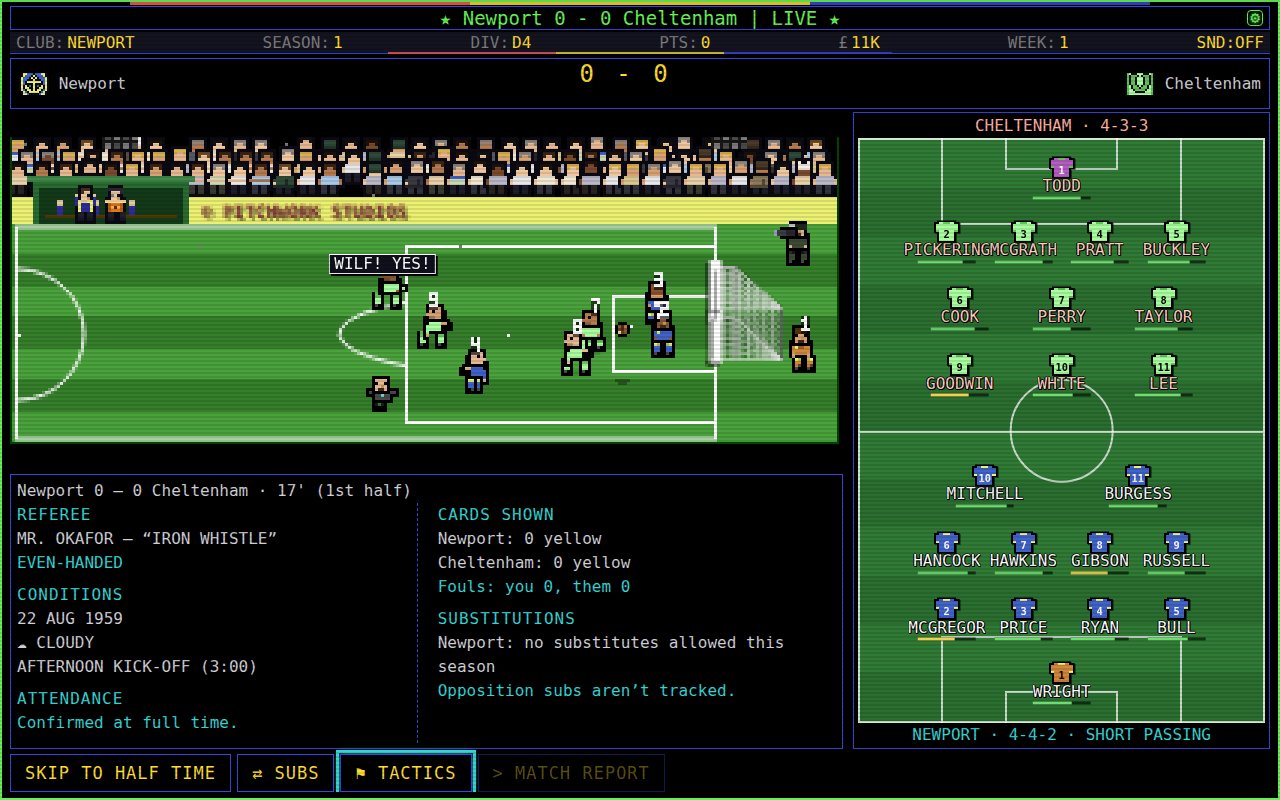
A live match on the Steam Deck: Newport against Cheltenham, the half-pitch view, the referee and conditions below, both formations alongside.
MATCHDAY, HANDHELDThe match on the left, both shapes on the right, the referee, the weather and the cards beneath. Subs and tactics stay on screen throughout.
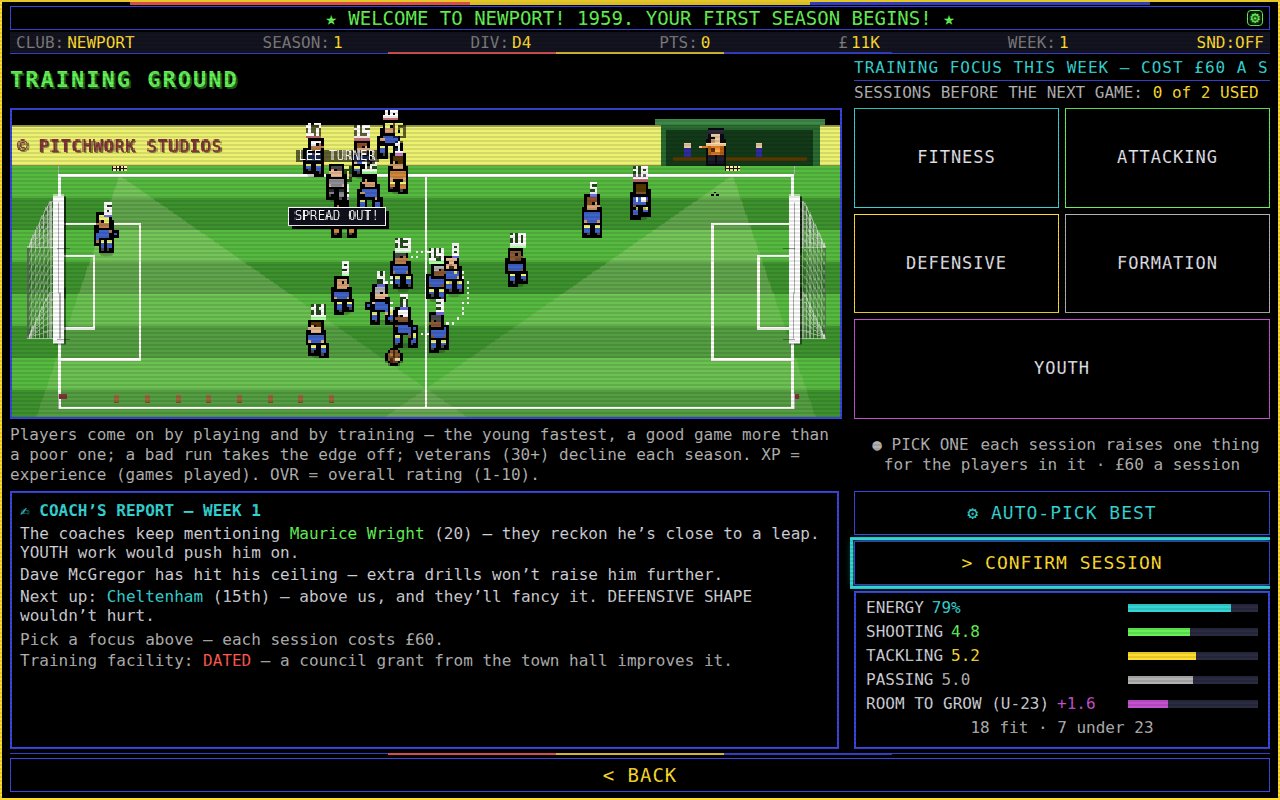
The training ground on the Steam Deck: the squad mid-session, the coach's report, and the five training focus choices.
TRAINING, HANDHELDThe five sessions as full-size buttons, the coach’s report and the squad’s numbers alongside. Pick one with a tap, or let AUTO-PICK BEST choose.

WHAT’S NEW

In the build going to Steam.

EVERY MAN IS REALEvery player in the League and below came up through a club’s own youth set up, and his whole career is on the record: the clubs, the loans, the fees, the games and the goals, to the day he hangs his boots up. The managers keep their records too.
YOUR LADS, WHEREVER THEY GOThe Academy keeps a tab on every lad you bring through: out on loan, released and looking, or making his way somewhere else. If one comes good elsewhere, go and buy him back. Apprentices first, YTS trainees from 1983.
THE CLUB RECORD BOOKTop scorers, most games, the record signing and sale, the biggest win and the heaviest defeat, the longest unbeaten run, the record gate and every honour, on Club Status.
WINTERFrost, fog, snow and waterlogged pitches put matches off, and the Big Freeze of 1962-63 wipes out weeks of the season. Games called off are played midweek later on, and the table shows games in hand.
THE RULES OF THE DAYThe maximum wage until 1961, retain and transfer until 1963, freedom of contract from 1978: every club plays by the rules of its year.
STEAM ACHIEVEMENTS, AND MORE TO SAYSeventeen achievements, from your first win to the summer of 1989, and hundreds of new lines for the Manor, the office, the coach, the captain, the commentary and the press.

WHO WE ARE

Pitchwork Studios, Cardiff. We take real inspiration from the games of the 80s and 90s. Not their limits, their honesty: a game you understood in thirty seconds, with real machinery running under a plain surface. That’s what we build now, with modern tools underneath a deliberately old surface. Every word anyone says in the game comes from our own Internal Intelligence system: dialogue written for the game and chosen by the moment, so we know exactly what the town can say. The simulation decides what happens; Internal Intelligence decides how it is said.


NOTHING RESETS

A club that remembers you. Every person keeps a record of what you did and said, for as long as thirty seasons.

Money that ages with you. Wages, fees and prices are priced honestly for whatever year the story has reached. 1959 money is not 1985 money.

A League that moves by the real rules. Ninety-two clubs going up and down on real tables, by the rules of each season: re-election, the Conference, and the first play-offs, which you play yourself.

A career that outlasts the job. Contracts run down, boards lose patience, and bigger clubs come calling. Lose the job and the career goes on somewhere else (a new town, a new pub, a new chairman, people who have never heard of you) and the town you left still remembers you if you ever go back. At the end of 1988–89 the final whistle goes on the lot, with a report on all thirty years.

Players with careers of their own. Every player in the game, yours or anyone’s, gets better by playing and by training, peaks at an age of his own, and fades his own way. The legs go before the touch.

A match played by the men in it. Every man on the ball reads the play and chooses for himself. A corner is a corner because the ball went out off a defender; a free kick is a free kick because a man was brought down on the ball.

Six people who actually run the club. The vice-chairman, the sponsor, a businessman, a councillor, the mayor, the supporters’ chair. Each wants something, and it moves the budget, the gate, and the job.

A matchday of its own year. Thirty seasons of what a ground looked and sounded like: the brass band and its drum, rattles and rosettes at a cup tie, toilet rolls over the goalmouth, the fences, the inflatables, plastic pitches in the 80s and the Saturday sports paper in pink.

The rules of the day, off the pitch too. The three-day week of 1974 and its early kick-offs, bookings that add up to a ban, the visitors’ share of the gate until 1983, the transfer deadline in March, and the ban from Europe in 1985.

A town that talks about what happened. The pub, the training ground, the press and the radio talk about this week (the result, the table, the signing, the weather) in lines written for the game and chosen for the moment.

30 OCTOBER 2026

£9.99 · $9.99 ON STEAM

Windows, Mac and Linux, with the Steam Deck and other handheld PCs alongside them. Wishlisting costs nothing and it genuinely helps a small studio.